Get help with "Google Maps Business Profile" from a professional.
Digital marketing professionals are the best ROI for your marketing spend.
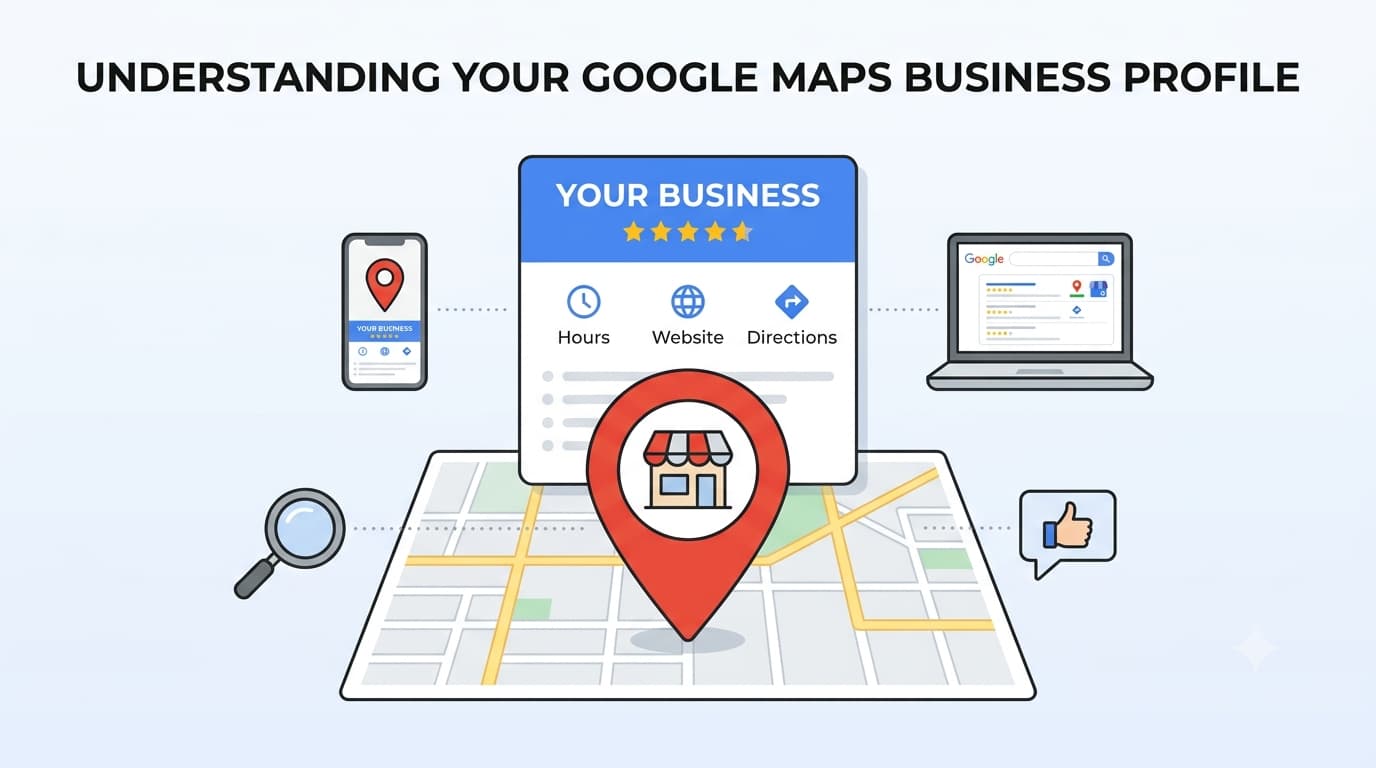
A Google Business Profile (or GBP) is the free business information listing that represents your business across Google Search and Google Maps.
Formerly known as “Google My Business,” it not only produces the pin on the map, but also the panel of business details on the right side of a desktop search, and every business detail shown in Google’s local results. For a business with a physical location, it is usually the first thing a customer sees before calling, and therefore one of a business’s most important marketing tools.
That’s the short answer. The longer one is worth your time, because the vocabulary around Google Maps is genuinely confusing. Here’s everything that goes into that listing and how the pieces fit together.
*Note: All of these principles apply to businesses globally, but there will be some comparisons to the South Korean local market made in this article, as InterCultural Communications Inc. is located in South Korea.
What does “Google Maps” mean exactly?
Usually when people say, “Google Maps”, they are generally talking about one of the 3 ways to access the map tools that Google Provides:
- Maps – browser based maps at maps.google.com
- App – downloadable Android and iOS apps
- Google Business Profile – business information management tools at business.google.com
Information from Google Business Profiles is displayed both in the maps and in Google search results in the following formats:
- The Local Pack
- The Local Finder
- The Knowledge Panel
What are Google Maps?
Google Maps combines satellite imagery with custom road data. Google sources satellite data from government agencies like NASA and private commercial providers, then stitches them into a seamless view. Then Google used “Street View” cars along with official records to map streets, addresses, and navigation routes to build the actual road map itself. This is also done by other maps like Korea’s Naver Maps or the community-built alternative that uses openly licensed data, OpenStreetMap.
What is the Local Pack?
When you search for something on Google – for instance, “coffee shop near me” – you are likely to see a box with three business listings and a small map right inside the search results, aka, the Local Pack. Sometimes also called the “Map Pack” or “3-Pack“, this box lives on Google’s normal search results pages (SERPs), not inside the Maps app. When most business owners say “I want to show up on Google Maps,” this is usually what they actually mean.
What is the Local Finder?
At the bottom of the Local Pack, there’s a “More places” link. Click it, and you’ll see an expanded list of businesses referred to as the Local Finder. It looks almost identical to the Maps app, but it’s still on Google’s search page. Here’s the surprising part: your rankings in the Local Finder can be noticeably different from your rankings in the Maps app itself. They use overlapping but not identical ranking signals.
What is a Knowledge Panel?
This profile also powers the Knowledge Panel — the block of business details that appears on the right side of a desktop Google search when someone searches your business name directly. Hours, photos, reviews, your website link, directions, and popular times all come from your GBP. It’s the same data source, appearing in a different place.
Who / What gets on Google Maps?
Any business, organization, or landmark can appear on Google Maps.
But here’s what you may not expect: Google often adds listings automatically, without the owner ever doing anything. They pull data from websites, directories, and other public sources and create a listing without anyone ever lifting a finger.
In addition to that, anyone can add anything they would like to add by clicking on “Add a Missing Place” like so:
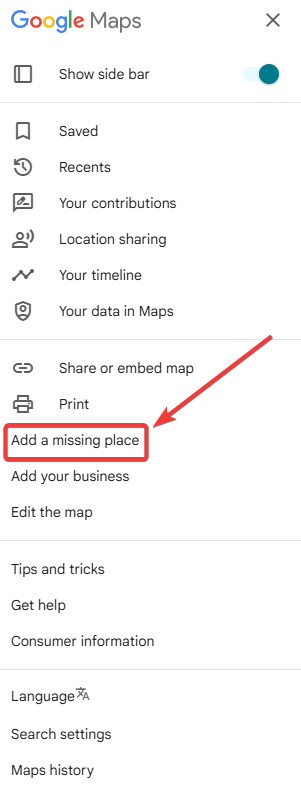
So someone could easily have already added your business! Multiple people may have even added your business, in which case there may even be duplicates.
Duplicates are particularly damaging to business owners because they split your reviews between two listings, confuse customers, and send mixed signals to Google — all of which hurt your rankings.
GBP can exist in one of 2 states:
- Unclaimed / Unverified Listings — The business appears on Google Maps but no one has taken ownership of it, meaning the information may be outdated, wrong, or incomplete.
- Claimed / Verified Listings — The business owner has verified ownership through Google, giving them full control over the information.
Verified businesses can correct their information, merge duplicates, and actually start doing the local SEO work to start climbing the ladder.
What is Local SEO?
Local SEO is everything you do to rank higher across all of these tools — optimizing your Google Business Profile, editing your website, earning reviews, posting updates, building citations, and more.
You manage your Google Business Profile to get it to show up in the Maps app, the Local Pack, the Local Finder and to create a comprehensive Knowledge Panel for your business. Local SEO is the ongoing work of optimizing all of it, along with your website, so more customers find you no matter where they’re searching.
Understanding Google’s SERP (Search Engine Results Page)
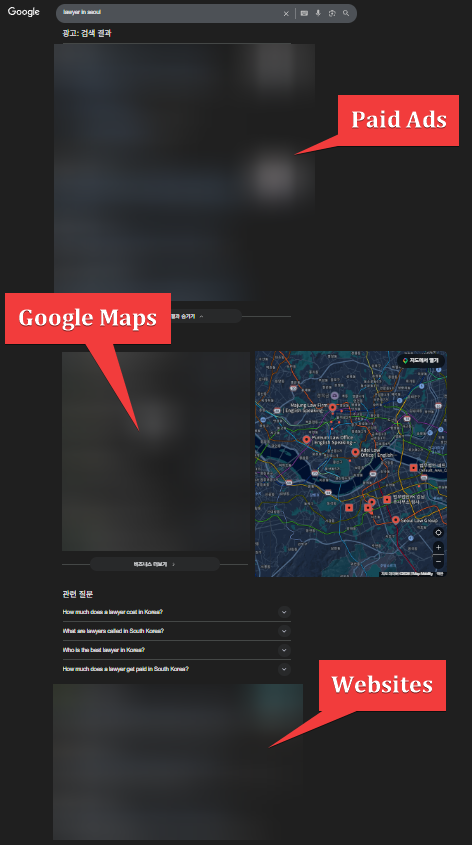
There are 3 ways to get to the top of Google. They are:
- Pay. (Also known as Google Ads.)
- Build a great website. (Also known as search engine optimization.)
- Make a great Google Business Profile. (Also known as local search.)
A typical Google search shows:
Sometimes There is no Local Pack
The first thing to keep in mind is that if the maps don’t show up, your GBP won’t show up.
If your target search is for a locally-based product or service, then Google is very likely to show maps to users. However, if your service is one that is not location-based and is instead provided from anywhere in the world, then Google is not likely to display maps at all.
As an example, InterCultural Communications targets potential clients who are seeking both “Google Ads agencies” and those who are seeking “website development”. However, you will likely find that if you search vanilla google for “Google Ads agency” then you will not see maps, but if you search for “website developers” then you will see a map at the top of Google. So we don’t even bother optimizing our GBP for “google ads agency” and instead we only aim for “website developer” in our area. We optimize our website itself for organic SEO instead of our GBP.
This is why, for location-based businesses like restaurants, clinics, gyms and yoga studios, it’s absolutely essential to focus on ranking at the top of Google Maps before moving on to your website and paid ads.
Why Google Maps Matter
As mentioned above, showing up at the top of Google Maps results can be the difference between just surviving or truly thriving.
Just this past February, BrightLocal’s 2026 Local Consumer Review Survey asked a representative panel of 1,002 US adults how they find a local product or service and the results were clear:
- 41% said they always read reviews when looking for a business
- That’s up from 29% the year before
- 31% said they will only use a business rated 4.5 stars or higher
- That’s also up from 17% the previous year
- 85% said they’re more likely to use a business after reading positive reviews; 77% are put off by negative ones. The bar has risen fast. A profile that was competitive two years ago now gets filtered out before a customer ever clicks.
Position on the map matters as much as reputation. First Page Sage’s meta-analysis of Google click-through data (2025) estimates
- the three visible Local Pack slots at roughly 17.6%, 15.4% and 15.1%
- when a Local Pack is present, the #1 organic result’s click-through rate falls from 39.8% to 23.7%.
- In other words, the Local Pack doesn’t just sit above the organic results — it takes a substantial share of the clicks that would otherwise have gone to them.
Being fourth isn’t a near miss; it’s practically invisible.
How important is it to get to the top of Google Maps? According to the Whitespark’s 2025 study of 540 manually-run queries across three US cities and six industries
- found local packs on 39% of queries overall, but that average hides the pattern that matters.
- Split by intent, packs appeared on more than 90% of straightforward local searches like “tacos San Francisco,” while AI Overviews showed up on only 15% of them.
- For informational queries the relationship inverts: AI Overviews on 92%, packs largely gone. Which is exactly the point made above — chase the commercial local searches, where the pack is almost always there and winning it is the most valuable thing you can do. Leave the informational questions to your website.
You may think, “But what about AI search. Isn’t that decreasing Google exposure?”
Though the numbers may look alarming at first, they’re quite deceptive. BrightLocal’s 2026 survey found that
- 45% of consumers now use tools like ChatGPT for local recommendations, which is up from 6% a year earlier
- Google’s share of local business searches fell from 83% to 71%.
However, AI Overviews, ChatGPT and Gemini are all pulling from the same underlying data — Google Maps, Google reviews, your website and related third party websites.
In other words, your Google Business Profile is one of the key factors that AI is researching to provide those answers, along with your website and other sites talking about your niche. And when Google Maps rank you at the top, those AI models tend to do the same thing.
The work hasn’t changed. It just has a second payoff.
The 3 Core Ranking Factors for Google Maps
Google determines Google Maps search ranking using three primary criteria: Proximity, Relevance, and Prominence. Understanding these three factors is the foundation of any Google Search ranking improvement strategy.
| Ranking Factor | What It Means | How to Optimize |
| Relevance | How closely your business matches the user’s search query | Accurate category setup, keyword-rich business description |
| Proximity | How close your business is to the searcher | Accurate address and correct map pin placement |
| Prominence | How well-known and trusted your business is online | Review count and rating, backlinks, media mentions |
Distance contributes roughly 15% to your ranking in 2025 — down from 25–30% in 2020. Relevance and prominence now do most of the work. A business farther away will consistently outrank a closer competitor that has a stronger, more complete profile.
Google’s algorithm also removes businesses seeking to deceptively rank outside their actual physical area. Be careful not to try to stretch beyond areas that clients would naturally be located.
What do you do with a Google Maps Business Profile?
At this point you understand the lingo – the Local Pack, the Local Finder, Knowledge Panel and Google Business Profile – as well as the three primary forces that decide who Google shows first – Relevance, Proximity, and Prominence.
Knowing what a GBP is and why it matters is the foundation, but a profile that exists doesn’t automatically rank. The businesses winning the Local 3-Pack today are the ones actively working every lever inside their profile and around it.
This is where the real work begins. In our companion guide, How to Rank Higher on Google Maps in 2026: 11 Crucial Steps we walk through the exact, step-by-step process — from claiming and verifying your listing to category selection, review generation, and website alignment — that turns a basic profile into a top-ranking one.
Since arriving in Korea in 1995, Steve has dedicated himself to learning about Korean language and culture. Since 2017, he's been helping companies practice data-driven digital marketing.